Government child support agencies operate at the intersection of public service, complex paperwork, strict compliance, and high stakes for families relying on timely payments. Historically, these agencies have managed a massive volume of documents, court orders, support applications, payment records and processed payments via multiple channels. But manual and legacy workflows, paper-based processing, and disjointed systems often lead to delays, errors, compliance risks, and inefficiencies.
Enter modern solutions based on intelligent payment and document automation. Fairfax Software is helping transform how child support agencies handle both documents and payments, delivering better accuracy, speed, and reliability while freeing staff to focus on mission-critical work.
The Pain Points in Traditional Child Support Processing
Before automation, many child support agencies wrestled with:
- High volumes of paperwork: every case brings in documents like applications, supporting documentation, court orders, amendments, notices, payment statements, etc. Manual sorting and filing of these contribute to backlog and inefficiency.
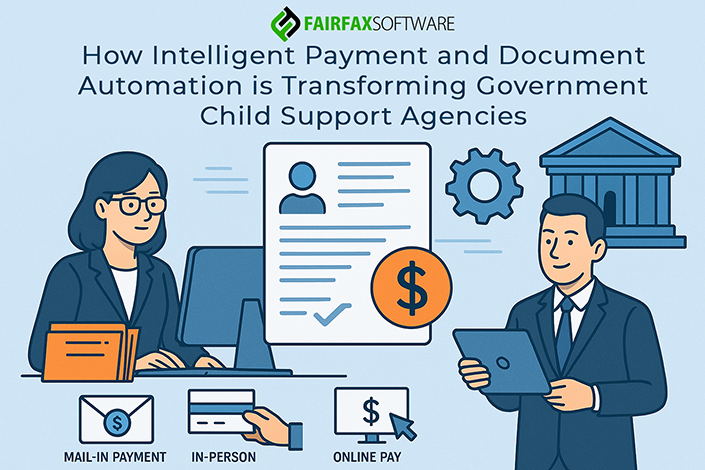
- Complex payment handling: agencies must accept and manage payments via mail-in checks, in-person payments, electronic payments, and sometimes multiple payment types per case. Handling and reconciling them manually is error-prone.
- Accuracy and compliance demands: mistakes in payment allocation or misfiled documents affect families relying on support and can have legal/regulatory consequences.
- Scalability constraints: as caseloads grow, manual workflows often can’t scale without massive increases in staff and resources, which increases cost and delays.
- Fragmented systems & data silos: documents, forms, payments, and records may live in different systems or physical filing cabinets, making retrieval, audit, and reporting cumbersome.
These challenges often result in slower payment processing, frustrated families, stressed staff, and greater risk of errors, a poor match for agencies whose mission is timely and accurate support for children and custodial parents.
How Intelligent Automation Changes the Game: The Fairfax Software Approach
Unified Payment and Document Handling
At the center of the transformation is the idea of unified processing, combining document intake, data extraction, payment processing, and workflow automation into a single platform. Fairfax Software’s flagship product, Quick Modules, offers just that: a robust, modular system that handles inbound documents and payments from multiple channels when you add the Quick Cashier and Quick Payment modules (mail-in, online, in-person) through a single workflow.
- Mail-in payments (checks, remittances) are digitized and processed through “lockbox”-style workflows.
- In-person payments, at over-the-counter windows or kiosks, can be processed via the same platform using card, cash, or check, enabling flexibility for custodial parents or payors.
- Online / electronic payments are managed via web portals, enabling electronic billing and e-payments seamlessly integrated into the workflow.
This unified “360-degree payment experience” simplifies reconciliation, ensures consistency across payment channels, and reduces the risk of lost or misallocated funds.
Turning Paperwork into Data. Intelligent Document Processing (IDP)
Perhaps even more transformative for child support agencies is document automation. Quick Modules leverages Intelligent Document Processing (IDP) driven by AI and deep-learning optical character recognition (OCR) to:
- Automatically classify and recognize inbound documents: whether they’re structured forms, semi-structured letters, scanned court orders, or free-form attachments.
- Extract relevant data: names, case numbers, payment amounts, dates, bank information, etc., regardless of whether the documents are machine-printed or handwritten.
- Validate data elements and structure data into searchable, standardized records. This dramatically reduces manual data entry, entry errors, and the burden on staff.
- Integrate with backend systems, once data is extracted, it can feed directly into case management systems, payment distribution engines, and reporting or compliance modules.
As a result, agencies are able to treat paperwork not as static paper files but as actionable digital data, searchable, sortable, linkable to payments and cases, and auditable.
Real Benefits: Speed, Accuracy, Compliance, and Scalability
By adopting intelligent document and payment automation, child support agencies can reap multiple tangible benefits:
- Faster processing times: what previously took days or weeks (mail-in payments, form intake, manual data entry) can now be processed much faster.
- Reduced error rates: automated data extraction and validation minimize human error in payment allocation, data entry, or case assignment, which improves service quality and reduces compliance risk.
- Improved staff productivity and morale: staff are freed from repetitive, manual, tedious tasks and can instead devote attention to higher-value work: customer service, case resolution, outreach, and audits.
- Strong compliance, auditability, and data security: the platform supports encryption, secure storage, audit trails, and adherence to relevant government standards for data privacy and integrity.
- Scalability and future-proofing: as caseloads grow or documentation volume increases, agencies can scale the platform (cloud or on-premise), add modules, and adapt workflows without major overhauls.
- Better service for recipients: faster turnaround, accurate payments, and reliable documentation mean custodial parents and families receive support more consistently, helping reduce financial stress and improving trust in the agency.
A Real-World Example: Child Support Services Modernization
In another blog post titled “Streamlining Government Child Support Services with Fairfax Software’s Quick Modules,” Fairfax Software outlines how child support agencies face “high volumes of paperwork,” “complex payment handling,” “manual processes,” “growing caseloads,” and “data security and compliance” issues, all of which Quick Modules addresses by offering digitization, automation, and integrated payment processing.
By automating document capture and payments, child support agencies can transform themselves from bureaucratic paperwork bottlenecks into responsive service providers. Instead of staff spending hours manually sorting mail-in payments, scanning checks, entering data, and linking documents to cases, the system does it, freeing up resources and reducing delays.
Why Now: The Growing Need for Automation in Social Services
Several factors make this an opportune moment for child support agencies to adopt intelligent automation:
- Increasing caseloads: Economic pressures, changes in family structures, and rising demand for child support services mean agencies are handling more cases than ever. Automation enables them to scale without proportional increases in staff.
- Budget pressures and cost savings: Agencies are often under budget constraints. Automation reduces labor costs, error-related costs, and overhead associated with paper storage and management.
- Regulatory and compliance demands: Privacy laws, audit requirements, and data security standards demand rigorous handling of sensitive data. Automated systems with encryption, audit trails, and compliance support help meet these requirements.
- Public expectation for digital services: Families expect modern, user-friendly, fast, and reliable service, including online payments, portal access, and quick processing. Automation helps agencies meet those expectations.
Conclusion: From Bottlenecks to Modern Service
Intelligent document and payment automation, as exemplified by Fairfax Software’s Quick Modules, is not just a technology upgrade. It represents a paradigm shift for government child support agencies.
By unifying payment processing across all channels and transforming paper-based documents into structured digital data, these agencies can become significantly more efficient, accurate, compliant, and responsive. For families relying on child support, and for the agency staff tasked with delivering it, that kind of modernization matters deeply.
In a world where speed, transparency, and reliability matter, intelligent automation helps child support agencies meet their mission: delivering support to children and families when they need it most.