Today’s customers expect convenient, secure ways to pay online. But for organizations managing multiple applications, departments, payment channels, and financial systems, delivering that experience can be more complicated than it appears.
Adding payment functionality to every application can require significant development, integration, and ongoing maintenance. At the same time, finance and operations teams need payment transactions to move efficiently from the customer-facing experience into merchant services, accounting, reconciliation, and reporting.
Fairfax Software’s Quick Payments provides an enterprise approach to electronic payment processing, helping organizations standardize online payments across multiple applications while connecting the customer payment experience with back-office financial processes.
As a web-based Enterprise ePayment Portal and extension of the Quick Modules platform, Quick Payments is designed to provide applications across an organization with access to common payment capabilities through Web Services APIs.
What Is Quick Payments?
Quick Payments is an enterprise ePayment solution designed to integrate electronic payment processing into an organization’s existing technology environment.
Instead of building and maintaining payment functionality separately within each application, organizations can use Quick Payments as a centralized payment platform.
Applications that require payment capabilities can connect to Quick Payments through Web Services APIs, allowing them to leverage common payment functionality without duplicating development efforts.
This approach can be particularly useful for organizations managing multiple systems, including government agencies, financial organizations, insurance companies, utilities, and other businesses that process customer payments.
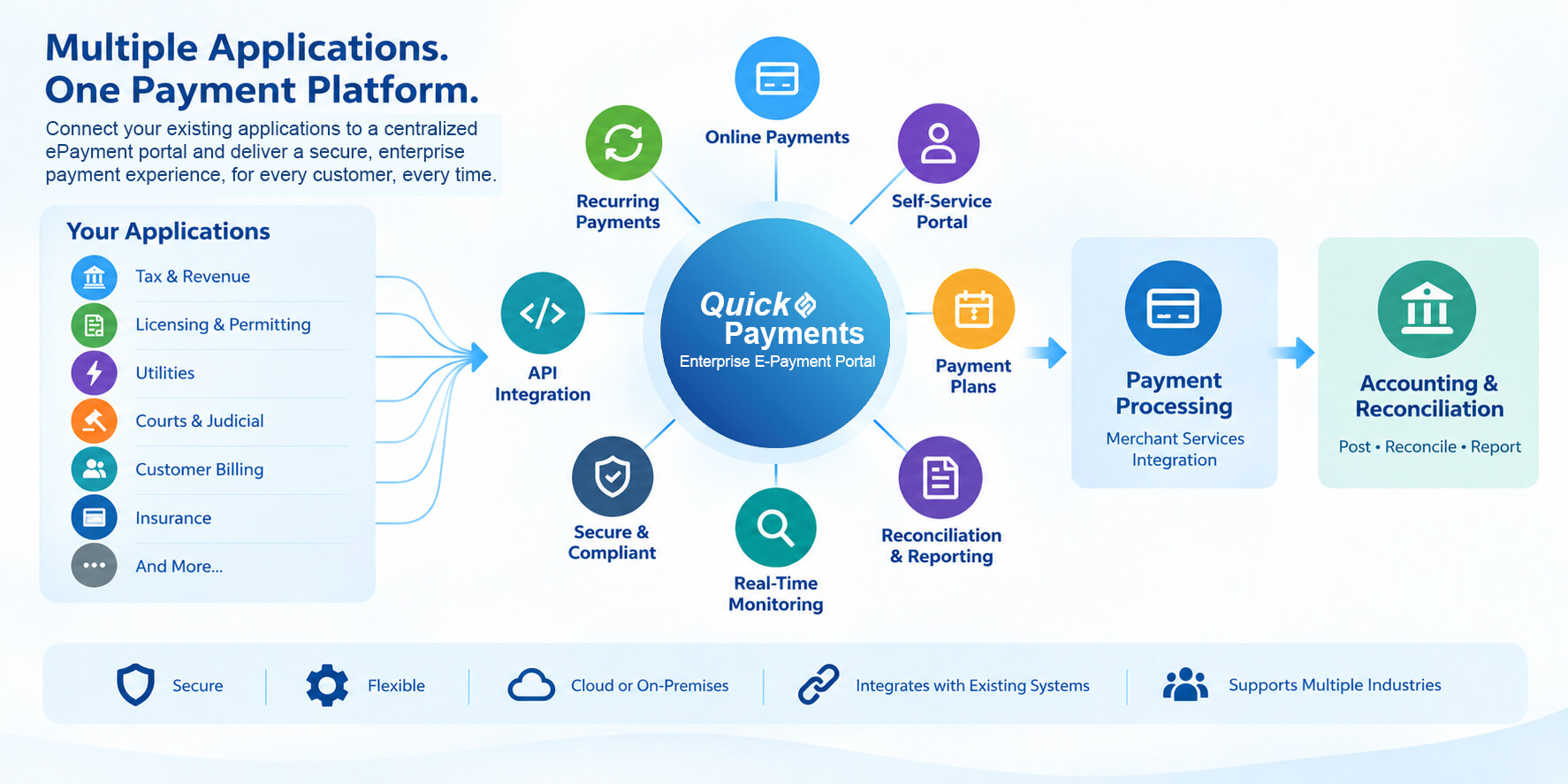
One Payment Platform for Multiple Applications
Organizations rarely operate from a single application.
A government agency, for example, may have separate systems supporting taxes, licensing, permits, utilities, courts, fees, or other services. A commercial organization may have different applications supporting billing, customer accounts, services, or lines of business.
Each system may have different requirements, but customers still expect a consistent and convenient way to make payments.
Quick Payments provides a common electronic payment platform that can connect with these applications.
Legacy Application Integration
Organizations don’t necessarily need to replace an existing application simply because it lacks modern payment functionality.
Quick Payments can work with legacy applications by allowing them to securely redirect customers through Web Services APIs. The application can provide customer and invoice information to Quick Payments, where the customer can complete the payment transaction.
This creates an opportunity to modernize the payment experience while continuing to leverage existing technology investments.
Supporting Multiple Payment Use Cases
One of the strengths of an enterprise payment platform is flexibility.
Quick Payments can support a variety of payment scenarios, including:
-
Online invoice payments
-
Customer account payments
-
Statement payments
-
Multiple invoices paid with a single transaction
-
Scheduled future payments
-
Payment plans
-
Recurring payments
-
Automatic payments
-
Customer self-service
-
Guest payments
Customers can also access payment history and paid invoices and download or print payment information.
This flexibility allows organizations to configure payment processes around their specific business requirements rather than forcing every customer or department into the same payment scenario.
Customer Self-Service Payments
Online payments are not simply about accepting a transaction.
Customers increasingly expect to manage their payment activity themselves.
Quick Payments provides self-service capabilities that can allow customers to manage accounts, research payment history, pay open invoices and statements, and access paid invoice information.
For organizations, this can provide a more convenient digital experience while helping move routine payment activities away from manual or staff-assisted processes.
For customers, it means greater visibility and control over their payment information.
Recurring and Scheduled Payments
Not every financial obligation is a one-time payment.
Organizations that manage ongoing accounts may need to support recurring payments, future-dated transactions, or structured payment plans.
Quick Payments provides capabilities for customers to schedule payments, establish payment plans, and set up recurring payments.
These capabilities can be useful across a range of applications where customers have recurring or installment-based obligations.
Connecting Online Payments With Back-Office Operations
A payment isn’t complete simply because a customer clicks “Submit”.
After a transaction is processed, organizations may need to post the payment, update an account, reconcile the transaction, generate financial records, and make the information available to accounting and other internal systems.
Quick Payments is designed to support this broader payment lifecycle.
The platform integrates with Merchant Services Providers and supports real-time and batch-based posting. It can also provide consolidated transaction files for financial-system integration, automate bank-statement reconciliation, and generate journal entries.
This connection between payment acceptance and back-office processing can help organizations create a more integrated payment workflow.
Payment Processing Across the Enterprise
For organizations with multiple applications, standardization can be an important consideration.
Without a centralized approach, each application may require its own:
-
Payment interface
-
Payment integration
-
Business rules
-
Maintenance
-
Customer experience
-
Reporting processes
-
Back-office connection
Quick Payments provides another approach: centralize common payment capabilities while allowing those capabilities to be accessed by applications across the enterprise.
The result is a payment environment designed around one platform supporting multiple applications and use cases.
Flexible Configuration and User Experience
Standardizing payment processing doesn’t mean every application has to look identical.
Quick Payments supports customizable screens that can be configured to match the look and feel of existing applications. Its template-based, point-and-click configuration also provides flexibility for organizations with different payment requirements.
This can help organizations introduce modern electronic payment capabilities while maintaining a familiar experience for customers.
Visibility Into Payment Activity
Payment operations require visibility.
Quick Payments includes a Workflow Monitor designed to provide real-time status updates and visibility into system activity. Automatic email notifications can also help keep customers and staff informed throughout the payment lifecycle.
For organizations processing payments across multiple applications or business functions, centralized visibility can help simplify monitoring and management.
Security and Data Management
Payment processing involves sensitive financial and customer information, making security and data management essential considerations.
Quick Payments incorporates secure SQL database management, legacy-system database lookups for validation, system audit capabilities, and encryption protocols.
Fairfax Software also supports payment solutions for any organization with hosted and on-premises deployment options, along with security and compliance practices designed for mission-critical environments.
Where Can Quick Payments Be Used?
The need for electronic payment processing extends across industries.
Quick Payments can support payment use cases for organizations such as:
Government Agencies
Government organizations can use electronic payment capabilities for applications involving taxes, fees, permits, licenses, utilities, judicial payments, and other services.
Fairfax Software specifically positions Quick Payments within its government portfolio as an Enterprise ePayment Portal for electronic billing and payment acceptance.
Insurance
Insurance organizations can use online payment capabilities to support customer billing and account payment scenarios.
Utilities
Utility providers can provide customers with convenient online access to bills and payment services.
Financial Services
Financial organizations can integrate electronic payment capabilities into applications supporting customer accounts and financial transactions.
Other Enterprise Applications
Any organization managing applications that require payment functionality can potentially benefit from a centralized ePayment approach.
From Online Payment to a 360-Degree Payment Experience
Online payments are one component of a broader payment environment.
Fairfax Software describes our 360-Degree Payment Experience as supporting incoming payments across mail-in, online, and in-person channels. Our Quick Modules solution supports mail-in payment processing, Quick Payments supports online payments, and our Quick Cashier solution supports over-the-counter transactions.
For organizations managing multiple payment channels, this creates an opportunity to look at payment processing as a connected operational process rather than a collection of independent systems.
Mail-in. Online. In-person.
Each channel may serve a different customer need, but organizations can benefit from taking a broader view of how payment data moves through the enterprise.
Why Enterprise ePayment Processing Matters
The goal of electronic payment processing isn’t simply to provide another way for customers to pay.
It’s about creating a payment experience that works for customers and the organization behind it.
An enterprise approach can help organizations address several common challenges:
Multiple applications: Connect payment capabilities to applications across the organization.
Legacy technology: Add modern payment capabilities without necessarily replacing existing applications.
Customer expectations: Provide convenient self-service payment options and access to payment information.
Recurring transactions: Support scheduled payments, payment plans, and recurring payments.
Back-office processing: Connect payment transactions with posting, reconciliation, and financial systems.
Operational visibility: Monitor payment activity and transaction status through centralized tools.
Standardization: Create a more consistent approach to electronic payment processing across applications.
A More Connected Approach to Electronic Payments
As organizations continue to modernize their digital services, payment processing should not have to exist in isolation.
The customer-facing payment experience, application environment, merchant services, accounting systems, and reconciliation processes all play a role in the complete payment lifecycle.
Quick Payments is designed to bring these pieces together.
By providing a centralized Enterprise ePayment Portal that can integrate with existing applications, Quick Payments gives organizations a flexible foundation for online payment processing across multiple use cases.
Whether the need is online invoice payments, customer self-service, recurring payments, legacy application integration, or back-office reconciliation, Quick Payments provides a configurable approach to enterprise electronic payment processing.
Explore Quick Payments
Learn how Fairfax Software can help your organization simplify and standardize electronic payment processing across your enterprise.