Every organization receives documents. Lots of documents.
Tax returns. Payment forms. Invoices. Applications. W-2s. 1099s. Correspondence. Claims. Scanned forms. PDFs. Emails and attachments. It can feel overwhelming.
The challenge isn’t receiving these documents. The challenge is turning the information inside them into accurate, usable data, quickly and securely.
For organizations processing large volumes of documents, Quick Modules +AI can reduce manual data entry, improve accuracy, accelerate processing, and create more efficient digital workflows.
That’s where Fairfax Software’s IDP software, Quick Modules +AI comes in.
Quick Modules +AI has combined artificial intelligence (AI), optical character recognition (OCR), machine learning, natural language processing, document classification, data extraction, data validation, and workflow automation to transform unstructured and semi-structured documents into structured, actionable data.
What Is Intelligent Document Processing?
In its simplest form, Intelligent Document Processing is the automated process of capturing information from documents, understanding what that information represents, extracting the relevant data, validating it, and delivering it to downstream systems and business processes.
Traditional document capture typically relies on predefined templates, fixed recognition zones, or manual data entry. IDP takes a more intelligent approach.
Instead of simply asking, “Where is the data on this page?” IDP can analyze the document and determine:
- What type of document is this?
- What information does it contain?
- Which fields are important?
- What does each field represent?
- Is the extracted information accurate?
- Does the information meet business rules?
- Where should the data go next?
The result is a transformation from unstructured documents to structured data that can be used by applications, databases, workflows, and automated business processes.
The Process
A typical workflow includes several stages:
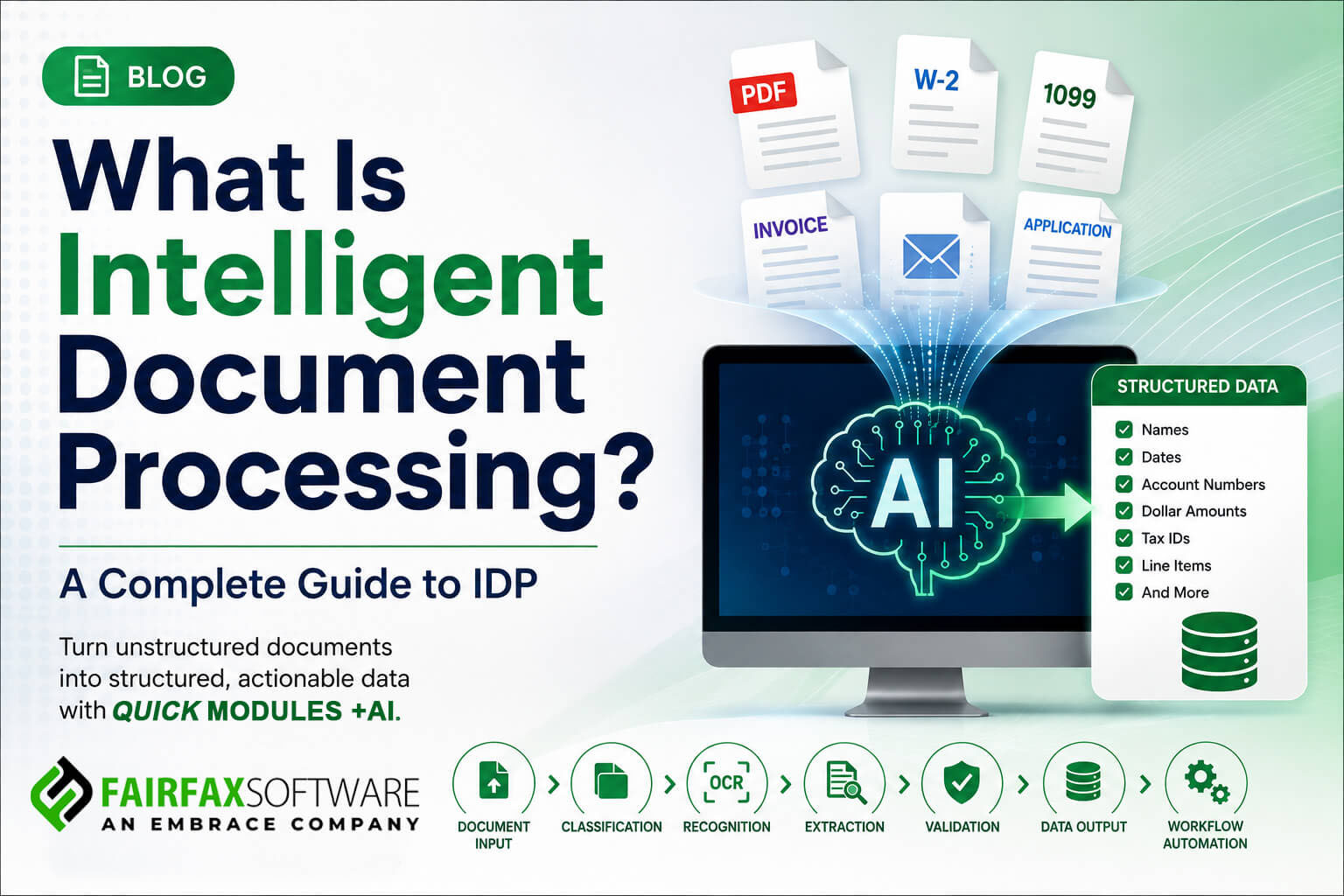
Document Input → Classification → Recognition → Extraction → Validation → Data Output → Workflow Automation
Each stage plays an important role in turning documents into usable information.
Why Is Intelligent Document Processing Important?
Many organizations still depend on employees to manually open documents, read information, type data into systems, verify results, and route documents to the appropriate department.
This approach can create several challenges.
Manual Data Entry Is Time-Consuming
Employees can spend hours entering information that already exists on a document.
IDP automates much of this work, allowing employees to focus on higher-value activities.
Manual Processing Can Introduce Errors
Human data entry can result in transposed numbers, missed fields, incorrect values, or other mistakes.
Automated recognition, validation, and business rules can help improve data quality and consistency.
Document Volumes Continue to Grow
Government agencies and businesses often process thousands or millions of documents annually.
IDP provides a scalable way to process large volumes without requiring organizations to increase manual labor at the same rate.
Documents Come in Many Formats
Modern organizations don’t receive information in one standardized format.
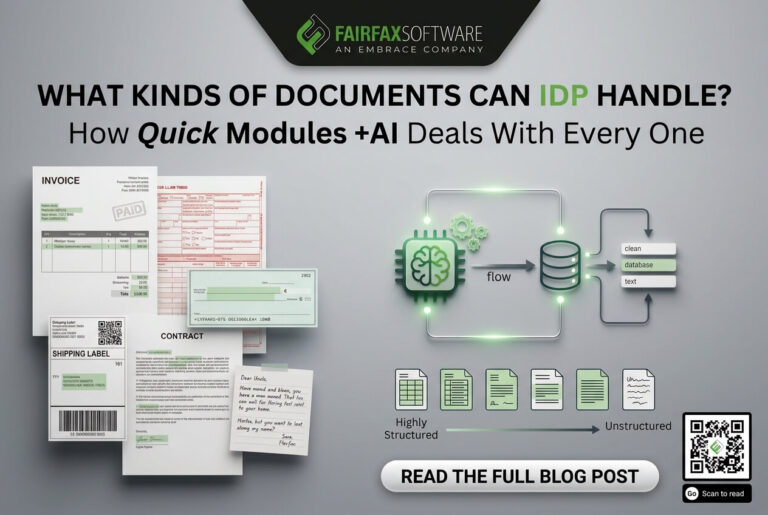
Documents arrive as:
- PDFs
- Scanned images
- Paper forms
- Tax forms
- Invoices
- Applications
- Checks
- Correspondence
- Emails and attachments
- Multi-page documents
- Structured and semi-structured forms
An effective IDP platform needs to handle this variety while maintaining accuracy and security.
What Technologies Make IDP Possible?
Intelligent Document Processing isn’t a single technology. It is an ecosystem of technologies working together.
Optical Character Recognition (OCR)
OCR converts printed or handwritten information in images and scanned documents into machine-readable text.
OCR provides the foundation for extracting information from many types of documents.
Artificial Intelligence and Machine Learning
AI and machine learning can help systems recognize document patterns, identify relevant information, and improve processing capabilities across different document types.
Document Classification
Before information can be extracted, the system needs to understand what it is looking at.
Classification identifies the document type. For example, a W-2, 1099, application, or correspondence.
Data Extraction
Once a document has been classified, IDP extracts relevant information such as:
- Names
- Addresses
- Account numbers
- Taxpayer identification numbers
- Dates
- Dollar amounts
- Form values
- Invoice numbers
- Payment information
- Tables and line items
The extracted information can then be converted into structured data.
Validation
Extraction alone isn’t enough.
IDP solutions can apply validation rules to determine whether extracted information is complete, logical, and consistent with established business requirements.
Low-confidence or exception items can be routed for human review.
Workflow Automation
The final step is putting the data to work.
Structured information can be sent to databases, enterprise applications, payment systems, case-management systems, RPA processes, or other business workflows.
Intelligent Document Processing vs. Traditional OCR
OCR and IDP are related, but they aren’t the same thing.
OCR primarily recognizes text.
IDP goes further by understanding, extracting, validating, and processing information.
For example, OCR might recognize the text:
Document Number: 12345
Total: $4,250.00
An IDP solution can identify that 12345 is the document number and $4,250.00 is the total, validate those values, and send them to the appropriate business system.
In other words:
OCR reads the document.
IDP understands the document and helps automate what happens next.
How Fairfax Software Applies Intelligent Document Processing
Fairfax Software has spent more than 30 years helping organizations automate high-volume document and data capture.
At the center of its technology portfolio is Quick Modules +AI, Fairfax Software’s flagship intelligent document processing and workflow automation solution.
Quick Modules +AI is designed to help organizations move beyond basic document scanning and recognition by combining AI-powered document processing, data capture, validation, workflow, and automation in a unified platform.
Quick Modules +AI: From Documents to Data to Action
Quick Modules +AI can help organizations process incoming information through a streamlined workflow:
Capture → Classify → Extract → Validate → Automate
This approach enables organizations to transform documents into structured data and then use that data to drive downstream processes.
AI-Powered Document Processing
As the name suggests, Quick Modules incorporates AI capabilities to help organizations process documents that may be difficult to handle using traditional template-based approaches.
This is particularly valuable when document layouts vary or when organizations need to process large volumes of forms and documents.
Virtual Batching
Organizations processing high volumes of incoming documents often need to separate, identify, and organize documents before they can be processed.
Quick Modules + AI virtual batching capabilities can help automate this process and reduce the amount of manual document preparation required.
Data Capture and Extraction
Quick Modules +AI can capture information from documents and transform it into structured data that can be used by downstream systems.
This can include information from government forms, tax documents, payments, applications, correspondence, and other business-critical documents.
Validation and Exception Handling
Not every document will be perfectly readable or conform to expected standards.
Quick Modules +AI can incorporate validation and exception processes so organizations can identify information that requires additional review rather than allowing questionable data to move automatically through the process.
Automation and Integration
The value of Quick Modules +AI extends beyond extraction.
Once information has been captured and validated, Quick Modules +AI can help move that information into existing workflows and systems.
This creates a connected process from document intake to business action.
Quick Modules +AI for Government
Government agencies are particularly well suited for Quick Modules +AI because they often process enormous quantities of documents containing sensitive and mission-critical information.
State revenue departments, treasurers, courts, child support agencies, motor vehicle departments, and other government organizations may process:
- Tax returns
- W-2s
- 1099s
- Payment documents
- Applications
- Correspondence
- Court documents
- Child support documents
- DMV forms
- Checks
- Remittance information
Manual processing can create backlogs and increase operational costs.
Quick Modules +AI helps government agencies automate repetitive document-intensive processes while improving the speed and consistency of data capture.
For Fairfax Software, this is a core area of our expertise.
Quick Modules +AI is the inbound processing engine behind 33 states and 43 state agencies, helping organizations modernize the way they capture and process incoming information.
Quick Modules +AI in Revenue Agencies
State and local revenue agencies are a particularly strong example of how Quick Modules +AI can create measurable operational value.
Revenue agencies receive enormous volumes of tax forms, payments, correspondence, and supporting documentation.
Historically, much of this information required manual handling.
With Quick Modules +AI, an agency can create a more automated process:
Documents arrive → Documents are classified → Data is extracted → Information is validated → Exceptions are reviewed → Data is delivered to the appropriate system
This can help reduce manual data entry while accelerating the movement of information into tax and revenue systems.
Processing W-2s and 1099s
Tax documents such as W-2s and 1099s present a significant document-processing challenge because formats and layouts can vary.
Quick Modules +AI is designed to help organizations automate the capture and processing of these forms, helping transform information contained within documents into structured data.
Fairfax Software also offers Quick Snippet, designed to automate the processing of W-2 and 1099 information and extend intelligent document processing capabilities to specific high-volume document types.
IDP and RPA: What’s the Difference?
Intelligent Document Processing and Robotic Process Automation (RPA) are complementary technologies.
IDP extracts and understands information.
RPA automates repetitive tasks based on that information.
For example:
- A document enters an organization.
- IDP identifies the document type.
- IDP extracts the relevant information.
- Validation rules verify the data.
- RPA or workflow automation moves the information into another system.
- The business process continues automatically.
Together, IDP and RPA can create a powerful automation ecosystem.
What Are the Benefits of Quick Modules +AI?
Organizations implementing Quick Modules + AI can achieve several benefits.
Increased Processing Speed
Automating document-intensive processes can significantly reduce the time required to capture and process information.
Reduced Manual Data Entry
Employees spend less time manually keying information from documents.
Improved Data Accuracy
Automated extraction and validation can reduce common data-entry errors.
Greater Scalability
Organizations can process increasing document volumes without relying exclusively on additional staff.
Better Employee Productivity
Employees can spend more time on exception handling, customer service, analysis, and other higher-value responsibilities.
Faster Access to Information
Once documents have been converted into structured data, that information can become available to downstream applications and workflows more quickly.
Improved Customer and Constituent Service
Faster processing can help organizations respond to customers, taxpayers, businesses, and constituents more efficiently.
What Should You Look for in an IDP Solution?
Not all Intelligent Document Processing platforms are created equal.
When evaluating an IDP solution, organizations should consider:
AI and Recognition Capabilities
Can the platform process different document types and layouts?
Accuracy
How accurately can it recognize and extract information?
Validation
Can the platform validate extracted information against business rules?
Human-in-the-Loop Processing
Can employees easily review and correct exceptions?
Workflow Automation
Can extracted information automatically trigger downstream processes?
Integration
Can the platform connect with existing enterprise applications, databases, and systems?
Scalability
Can it handle high-volume document processing?
Security
Does the solution support the organization’s security, compliance, and deployment requirements?
Deployment Flexibility
Can the organization deploy the solution in the cloud, on-premises, or in a hybrid environment when required?
These considerations are especially important for government agencies and other organizations processing sensitive information; Quick Modules +AI checks all the boxes.
The Future of Quick Modules +AI
Quick Modules +AI is evolving rapidly.
Traditional OCR-based capture is increasingly being augmented by Quick Modules +AI because of its machine learning, large language models, and more sophisticated document understanding technologies.
The next generation of intelligent document processing will increasingly focus on more than simply extracting data.
The goal is to understand documents, make processing decisions, validate information, and initiate business processes automatically.
This evolution is creating opportunities for organizations to build increasingly intelligent workflows while maintaining human oversight where it matters.
For organizations beginning their AI journey, Quick Modules +AI can also represent a practical starting point.
Instead of attempting to automate an entire business process at once, organizations can identify a document-intensive process, automate data capture and validation, measure the results, and expand from there.
Quick Modules +AI Is More Than Document Capture
The fundamental value of Quick Modules +AI is simple:
Turn documents into data. Turn data into decisions. Turn decisions into action.
For organizations processing large volumes of documents, the opportunity isn’t simply to scan documents faster.
It’s to create an intelligent, connected process that moves information from the point of intake through validation and into the systems and workflows that run the organization.
That’s the vision behind Quick Modules +AI.
By combining intelligent document processing, AI, data capture, validation, workflow, and automation in a unified platform, Quick Modules +AI helps organizations modernize document-intensive operations and build a more efficient path from incoming information to completed business processes.
Ready to Modernize Your Document Processing?
If your organization is still relying heavily on manual data entry, disconnected capture tools, or legacy document-processing workflows, Quick Modules +AI is your opportunity to improve efficiency, accuracy, and scalability.
Fairfax Software can help.
Learn how Quick Modules +AI can help your organization capture information, transform unstructured documents into structured data, automate workflows, and modernize document processing.
One Solution. One Workflow. One Provider.
Explore Fairfax Software’s Quick Modules +AI and discover what’s possible with Intelligent Document Processing.